

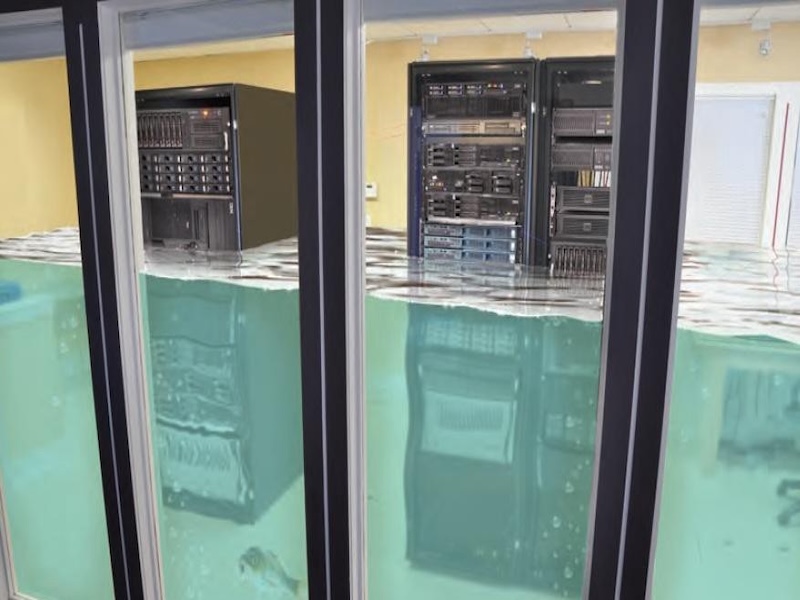
Flood Recovery and Secondary Server Room Implementation
Sector: Professional Services
Practice: DeliveryAssure and CyberAssure — Infrastructure Recovery and Resilience Uplift
Objective: Assure rapid recovery from a critical infrastructure incident, restore business continuity, and deliver a more resilient environment to protect against future disruption.
When Infrastructure Failure Forces the Issue
A mid-sized organisation suffered a critical incident when its primary server room was flooded, threatening business continuity and risking long-term equipment damage. Servers, patch panels, UPS units, and supporting infrastructure were all compromised. While insurance covered replacement hardware, the organisation faced a more complex challenge: restoring services rapidly, managing corrosion risk across affected components, and using the rebuild as an opportunity to establish a genuinely resilient environment — not just a like-for-like replacement.
The incident exposed what many organisations discover too late — that recovery capability, redundancy architecture, and infrastructure resilience are not tested until they are needed.
The 123.EXPERT Approach
123.EXPERT engaged two network specialists with expertise in disaster recovery, infrastructure deployment, and vendor coordination — deployed under structured delivery oversight consistent with 123.EXPERT’s assured delivery model. The engagement addressed recovery and resilience simultaneously:
- Data recovered from compromised servers, ensuring integrity and continuity of operations from the outset.
- Patch panels replaced pre-emptively to eliminate corrosion risk before it became a secondary failure point.
- Temporary server room established to provide operational stability during the recovery period.
- Vendors coordinated to procure and configure new servers, patch panels, UPS units, and supporting hardware under delivery oversight.
- Utility room converted into a secondary server room, deploying secondary Windows domain controllers for genuine resilience.
- Storage replication implemented between server rooms to protect against future hardware or site failures.
- 10Gb backbone interconnect installed between rooms, ensuring performance and redundancy under load.
Outcome
Business services were restored rapidly, minimising downtime despite the scale and complexity of the incident. The new dual-server-room configuration delivered improved resilience, fault tolerance, and disaster recovery capability that the organisation did not have before the incident.
The infrastructure rebuild addressed not just the immediate failure but the underlying vulnerabilities it exposed — storage resilience, domain controller redundancy, and physical infrastructure separation. Each of these directly strengthens the organisation’s cyber resilience posture by reducing single points of failure, improving recovery time objectives, and establishing the physical and logical redundancy that modern cyber risk frameworks require.
Through 123.EXPERT’s network-based delivery model, the organisation achieved both assured recovery and a forward-looking infrastructure uplift — emerging from the incident with a significantly stronger operational and cyber resilience foundation than existed before it occurred.
